In commercial automated retail, hardware engineering extends far beyond refrigeration performance and digital payment integration. To deploy equipment legally and safely across public and workplace environments—such as transit hubs, hospitals, universities, factories, and corporate campuses—manufacturers and operators must satisfy two core regulatory pillars: vending machine ADA compliance (alongside applicable international accessibility frameworks) and industrial safety standards governing structural, mechanical, electrical, and food-hygiene performance.
Overlooking these technical requirements during design or site installation can delay vending machine permits, trigger inspection failures, or require costly hardware retrofits. Below is an engineering-grade guide to ADA requirements for vending machines, vending machine accessibility, control ergonomics, UL 751 mandates, IEC 60335-2-75 provisions, and food sanitation compliance.
1. What Are the ADA Requirements for Vending Machines?
For vending machines installed in a public or common use area, at least one vending machine of each type shall be fully vending machine ADA compliance as outlined in 228.1 of the 2010 ADA Standards for Accessible Design and parallel Architectural Barriers Act [ABA] requirements for federal facilities, including Section 308 (Reach Ranges) and Section 309 (Operable Parts). All user-facing controls that will be used to facilitate a transaction, such as selection keypads, touchscreens, card readers, coin slots, bill validators, and product pick-up doors, must be within designated spatial limits.
ADA Reach Range and Height Requirements
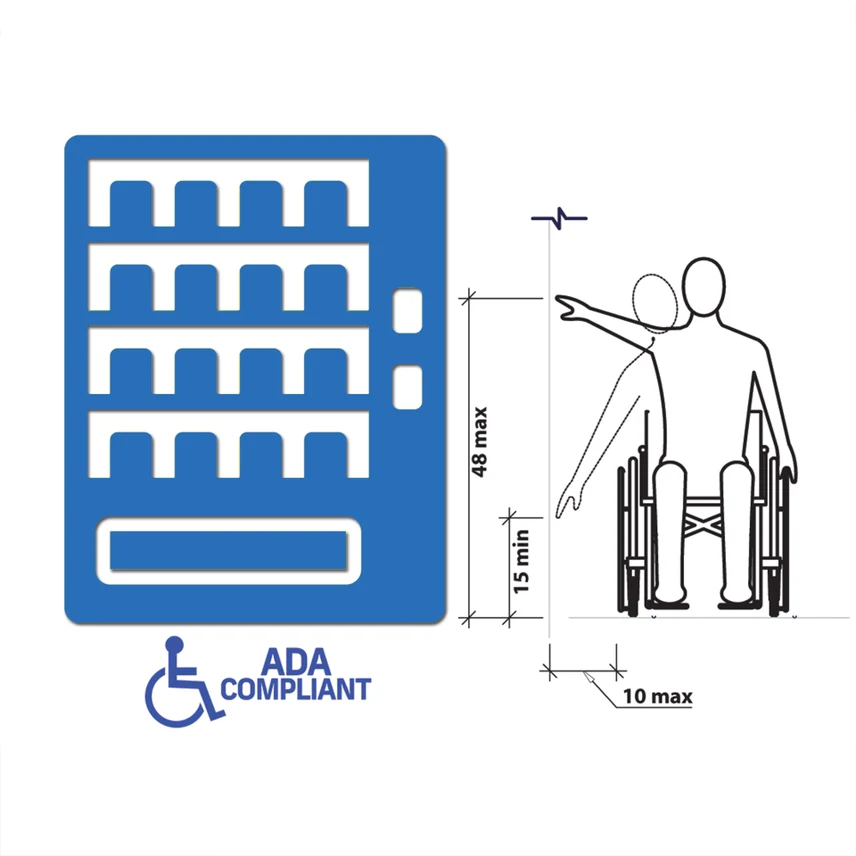
ADA requirements for vending machines specify exact vertical reach limits depending on whether a user approaches from the front or side, and whether any base ledge, counter, or protective barrier obstructs forward movement:
Unobstructed Forward and Side Reach (Sections 308.2.1 & 308.3.1):
Maximum Operable Height: 48 inches (1,220 mm) above the finished floor. No interactive selection button, primary touchscreen icon, or payment terminal may exceed this upper limit.
Minimum Operable Height: 15 inches (380 mm) above the finished floor. Product retrieval chutes, coin return cups, and lower delivery flaps must not require users to reach below 15 inches.
Obstructed Forward Reach (Section 308.2.2): When reaching over a counter, ledge, or protruding cabinet base, maximum allowable heights tighten based on horizontal reach depth. For an obstruction depth between 20 and 25 inches (510–635 mm), the maximum operable height drops to 44 inches (1,120 mm), provided clear knee and toe space extends beneath the obstruction.
Obstructed Side Reach (Section 308.3.2): Over an obstruction up to 34 inches (865 mm) high, if the reach depth exceeds 10 inches (255 mm) (up to a 24-inch maximum), the maximum operable height drops from 48 inches to 46 inches (1,170 mm).
Clear Floor Space and Accessible Routes
Designing an ADA compliant vending machine is ineffective if site placement blocks wheelchair access or fails local building inspections required for vending machine permits:
Clear Floor Space (Section 305.3): Operators must provide a level, firm, slip-resistant clear floor area measuring at least 30 × 48 inches (760 × 1,220 mm) positioned for either a forward or parallel approach, completely clear of door-swing arcs.
Accessible Approach Route (Section 403.5.1): The walkway leading to and passing the machine must maintain a minimum clear width of 36 inches (915 mm) so the cabinet's depth does not create a corridor bottleneck.
ADA Reach Range and Dimensional Specifications
| Compliance Parameter | Reach Condition | Mandatory Requirement | 2010 ADA Reference | Engineering & Installation Note |
| Max Control Height | Unobstructed Forward / Side | 48 inches (1,220 mm) max | Sections 308.2.1, 308.3.1 | Applies to top buttons, card readers, and bill acceptors. |
| Min Control Height | Unobstructed Forward / Side | 15 inches (380 mm) min | Sections 308.2.1, 308.3.1 | Applies to product pickup chutes and coin return slots. |
| Max Control Height | Obstructed Forward (20–25 in. depth) | 44 inches (1,120 mm) max | Section 308.2.2 | Requires compliant knee/toe clearance beneath obstruction. |
| Max Control Height | Obstructed Side (>10–24 in. depth) | 46 inches (1,170 mm) max | Section 308.3.2 | Applies when reaching sideways over a base up to 34 in. high. |
| Clear Floor Space | Level Approach Zone | 30 × 48 inches (760 × 1,220 mm) min | Section 305.3 | Must remain unobstructed by adjacent bins or walls. |
| Accessible Route | Pedestrian Corridor | 36 inches (915 mm) min width | Section 403.5.1 | Machine footprint must not narrow hallway clearance. |
| Actuation Force | One-Hand Operation | 5 lbf (22.2 N) max | Section 309.4 | No tight grasping, pinching, or wrist twisting permitted. |
ADA Compliance Checklist for Vending Machine Installation
Before commissioning a machine on-site or applying for municipal vending machine permits, operators and facility managers should verify six practical checkpoints to guarantee vending machine ADA compliance:
Control Height: Confirm that all selection buttons, active touchscreen controls, bill validators, and aftermarket card readers sit within the 15–48 inch accessible reach envelope (or 44-inch limit if obstructed).
Clear Floor Space: Verify a 30 × 48 inch unobstructed, level floor area directly in front of the user interface and delivery chute.
Accessible Route: Ensure hallway or lobby clearance remains at least 36 inches wide after installation, accounting for rear ventilation gaps.
Payment Access: Check that aftermarket NFC/credit card readers mounted during field retrofits do not sit above the 48-inch ceiling.
Product Retrieval: Test the delivery chute door to confirm items can be retrieved easily without reaching below 15 inches or fighting stiff springs.
Operating Force: Verify that coin return levers, pushbuttons, and delivery flaps open smoothly with one hand using 5 lbf or less.
2. How Should Vending Machine Buttons and Touchscreens Be Designed for Accessibility?
Achieving true vending machine accessibility requires engineering physical controls and digital interfaces so users with limited upper-body mobility, low vision, or blindness can complete purchases independently.
Button Height and Operating Force
Under Section 309.4, button height must remain within the 15–48 inch vertical zone, and every mechanical control must operate with one hand using no more than 5 pounds-force (22.2 N). Controls cannot require tight grasping, pinching, or twisting of the wrist. Heavy, spring-loaded retrieval flaps or stiff coin-return mechanisms frequently fail field inspections when actuation force exceeds this threshold.
Tactile Controls, Braille, and Audio Guidance
Although Section 309 of the 2010 ADA Standards is more concerned with reach ranges and mechanical operability, vending machine accessibility includes multi-sensory navigation aids to provide accessibility to blind and low vision consumers.
Tactile Markings and Identification: Physical numeric keypads should feature raised tactile indicators (such as a raised nib on the "5" key) and distinct physical separation between buttons.
Braille and Audio Guidance: Where applicable—particularly in public transit hubs, government buildings, and educational campuses—operators deploy raised Braille labels alongside voice-guided navigation via headphone jacks or tactile navigation buttons.
Clear Visual Feedback: High-contrast price displays, illuminated selection indicators, and audible confirmation tones help users with low vision verify selections and payment status.
Accessibility Requirements for Smart Vending Machine Touchscreens
Smart vending machines have become more than just a keypad and button machine and are now using large vertical displays (e.g. 21.5", 32") as a menu, with top areas frequently exceeding 48". Without tactile feedback, capacitive touchscreens need to be developed with hardware and software modifications to maintain vending machine ADA compliance:
Persistent "Accessibility Mode" Icon below 48 inches: Software should have a "Accessibility Mode" icon. It moves all interactive product grids, filter tabs and checkout prompts into the lower 15-48 inch reach zone for people in wheelchairs.
Independent Payment Terminal Placement: On-screen tap-to-pay is not accessible for blind users and will require physical card readers, tactile keypad payment terminals, and cash acceptors that are independent of the on-screen terminal and within the 15–48 inch envelope.
The 2010 ADA Standards do not specify exact pixel sizes for vending machines, but manufacturers can increase vending machine accessibility by applying the Web Content Accessibility Guidelines (WCAG 2.2) principles to vending machine UI designs where applicable: generously sized touch targets (24 × 24 CSS pixels at Level AA, or 44 × 44 CSS pixels for enhanced user ergonomics), a text-to-background contrast ratio of at least 4.5:1, clear menu hierarchy and navigation, and using voice prompts or alternative tactile navigation when touchscreen interaction is not feasible.
3. What Safety Standards Apply to Commercial Vending Machines?
Beyond ADA requirements for vending machines, commercial safety is governed by rigorous electrical, mechanical, and structural standards designed to protect consumers and technicians from shock, tipping, entrapment, and thermal hazards—all of which are routinely reviewed when securing commercial vending machine permits.
UL 751 Vending Machine Safety Requirements
In North America, UL 751 (Standard for Vending Machines) is the primary safety benchmark covering electrical insulation, refrigeration circuits, flammability, mechanical guards, and structural stability. Manufacturers and importers must track ongoing revisions—specifically UL 751: Vending Machines — Updated Requirements Effective June 2026 (per UL 751:2016 Ed.9+R:18Dec2024 updates taking effect June 12, 2026), which introduce stricter criteria for glass panels, cabinet integrity, control components, and protective enclosures. (Note: Specific edition applicability and compliance deadlines should always be verified against official UL documentation and Nationally Recognized Testing Laboratory [NRTL] certification filings.)
IEC 60335-2-75 Safety Requirements
For European and international markets, IEC 60335-2-75 (Particular requirements for commercial dispensing appliances and vending machines) governs electrical and mechanical safety. It addresses moisture resistance, abnormal operation protection, thermal cut-outs, and mechanical hazard prevention across indoor and outdoor commercial environments.
Cabinet Stability and Anti-Tip Protection
A fully stocked refrigerated beverage or multi-tier spiral machine routinely weighs 600 to 1,100 lbs (270–500 kg), making anti-tip engineering critical:
Inclined Plane Stability Testing: Under UL 751 and IEC 60335-2-75, cabinets must pass tilt stability tests on inclined surfaces (typically 10 degrees) without tipping—both when empty and when fully loaded with internal service trays extended.
Leveling Feet and Structural Anchoring: Installations in transit stations, schools, or seismic zones require heavy-duty adjustable leveling legs and floor or wall anti-tip brackets.
Riser and Plinth Precautions: Operators must avoid placing machines on tall wooden pallets or masonry bases that compromise center-of-gravity stability or push operable controls above the 48-inch ADA limit.
Pinch-Point, Entrapment, and Glass Safety
Delivery Chute Anti-Entrapment: Retrieval compartments require one-way security baffles or interlocked motorized elevator doors that prevent children from reaching upward into dispensing spirals, belts, or lift carriages.
Safety Glazing: Front display windows must use tempered safety glass or impact-resistant laminated glazing so accidental breakage produces blunt granular fragments rather than sharp shards.
Deburred Edges and Corners: Sheet-metal housings, retrieval flaps, and coin bezels must feature smooth, chamfered edges to prevent hand injuries during blind reach operations.
Electrical Safety and OSHA Lockout/Tagout
Meeting electrical safety requirements protects both end users and maintenance personnel:
Ground-Fault and Ingress Protection: Machines installed in semi-outdoor concourses or damp environments require GFCI (Ground Fault Circuit Interrupter) protection, redundant chassis grounding, and appropriate ingress protection ratings (such as IP54 for weather-exposed locations).
OSHA Lockout/Tagout (LOTO) and Servicing Safety: In U.S. workplaces, OSHA 29 CFR 1910.147 governs the control of hazardous energy during equipment servicing where unexpected energization or startup could injure technicians. Compliant machines incorporate accessible main power disconnect switches, insulated high-voltage barriers around compressors and power supplies, clear hazard warning labels, and documented technician servicing procedures.
Global Regulatory Standards Comparison by Market
| Target Market | Primary Standard / Framework | Core Regulatory Focus |
| United States | 2010 ADA Standards (Sections 228, 308, 309) / OSHA 1910.147 | Accessible reach ranges (15–48 in.), actuation force (≤5 lbf), and workplace servicing safety. |
| North America | UL 751 / NSF/ANSI 25 | Electrical/mechanical product safety (UL 751) and food-zone sanitation (NSF/ANSI 25). |
| International | IEC 60335-2-75 | Global electrical, thermal, and mechanical safety for commercial vending appliances. |
| European Union | CE Conformity Requirements / EN 301 549 (where applicable) | Applicable EU safety/EMC directives, plus ICT accessibility standards for digital self-service terminals. |
| Japan | Applicable PSE Requirements | Electrical Appliance and Material Safety Act compliance for regulated electrical components. |
4. How Can Manufacturers Design Vending Machines for Regulatory Compliance?
It is far less expensive to build compliant equipment when vending machine accessibility, mechanical safety and sanitation of vending machines are built in from the beginning, as opposed to built later in the field.
Improving the accessibility and safety of smart vending machines.
Modern automated retail cabinets are an amalgamation of ergonomics and smart software. Card readers, bill acceptors, and primary touch screen areas are visually integrated within the 15–48 inch reach envelope to immediately achieve vending machine ADA compliance and motorized delivery elevators eliminate low bending at the bill retrieval chute. Combined with tempered safety glazing, reinforced anti-tip frames and isolated electrical compartments, smart hardware provides protection for end users and field technicians.
The standards and guidelines for food safety and sanitation
Refrigerated food, fresh produce and beverage machines must be installed in accordance with electrical safety standards in conjunction with the NSF/ANSI 25 (Vending Machines for Food and Beverages) standard for hygiene. NSF/ANSI 25 sets stringent sanitary requirements for materials used in the food zone, smooth interior surfaces that are easy to clean, splash zone protection, sealing of cabinets to prevent pests and proper temperature control with automated health-lock for interior cooling temperatures that exceed safe food-storage limits. To obtain food-service vending machine permits, NSF/ANSI 25 must be met in addition to inspections by local health departments.
Choosing a Reliable Vending Machine Manufacturer
For operators and distributors scaling across international regions, partnering with an experienced OEM ensures smooth regulatory approvals and faster vending machine permits. Xi'an Zhigou Intelligent Technology Co., Ltd. (Zhigou Tech) engineers commercial touchscreen, AI vision, and refrigerated vending solutions around international ergonomic and safety benchmarks—integrating accessible 15–48 inch control layouts, low-force ergonomic retrieval doors, food-grade insulated interiors, and robust electrical architectures designed to satisfy applicable product safety standards and conformity requirements in target markets, including UL standards in North America, relevant EU conformity requirements, and applicable PSE requirements in Japan.
Frequently Asked Questions
What are the ADA requirements for vending machines regarding button and card reader height?
Under Sections 308.2.1 and 308.3.1 of the 2010 ADA Standards, the highest operable part—including selection buttons, active touchscreen icons, bill validators, and aftermarket cashless card readers—must not exceed 48 inches (1,220 mm) above the finished floor. If a user must reach forward over a 20-to-25-inch deep obstruction, the maximum operable height drops to 44 inches (1,120 mm).
What is the minimum height for vending machine controls and pickup doors?
Under Section 308 of the 2010 ADA Standards, the lowest operable component—such as a product delivery chute or coin return cup—must sit at least 15 inches (380 mm) above the finished floor.
Can adding an aftermarket cashless card reader violate vending machine ADA compliance?
Yes. One of the most common field compliance violations occurs when an operator mounts a retrofit NFC or credit card reader onto the upper cabinet above 48 inches. Any added payment terminal must be installed within the 15–48 inch accessible reach range.
How do large touchscreen vending machines improve vending machine accessibility?
Machines equipped with tall vertical touchscreens whose upper sections exceed 48 inches comply by providing an "Accessibility Mode" button positioned below 48 inches. Activating this mode shifts all interactive menus and checkout buttons into the lower 15–48 inch zone and pairs with separate tactile payment terminals and audio guidance.
Do ADA and safety standards affect vending machine permits?
Yes. Local municipalities, building inspectors, and health departments routinely verify vending machine ADA compliance (clear floor space, corridor clearance, and reach heights) alongside UL 751 electrical safety and NSF/ANSI 25 food sanitation certifications before approving vending machine permits for public buildings, schools, and transit hubs.
What is the difference between UL 751, IEC 60335-2-75, and NSF/ANSI 25?
UL 751 governs electrical, mechanical, and structural safety for vending machines in North America (with updated requirements taking effect in June 2026), while IEC 60335-2-75 serves as the corresponding international electrical and mechanical safety standard. NSF/ANSI 25, by contrast, governs food protection, cleanability, and sanitation design for food and beverage vending machines.
References
U.S. Department of Justice. (2010). 2010 ADA Standards for Accessible Design (Sections 228.1, 305, 308, 309, and 403).
https://www.ada.gov/law-and-regs/design-standards/2010-stds/ Underwriters Laboratories (UL). UL 751: Standard for Vending Machines (including updated requirements effective June 2026).
International Electrotechnical Commission (IEC). IEC 60335-2-75: Household and similar electrical appliances – Safety – Part 2-75: Particular requirements for commercial dispensing appliances and vending machines.
NSF International. NSF/ANSI 25: Vending Machines for Food and Beverages.
https://www.nsf.org/ U.S. Department of Labor – OSHA. The Control of Hazardous Energy (Lockout/Tagout) Standard (29 CFR 1910.147).
https://www.osha.gov/ World Wide Web Consortium (W3C). Web Content Accessibility Guidelines (WCAG) 2.2.
https://www.w3.org/TR/WCAG22/