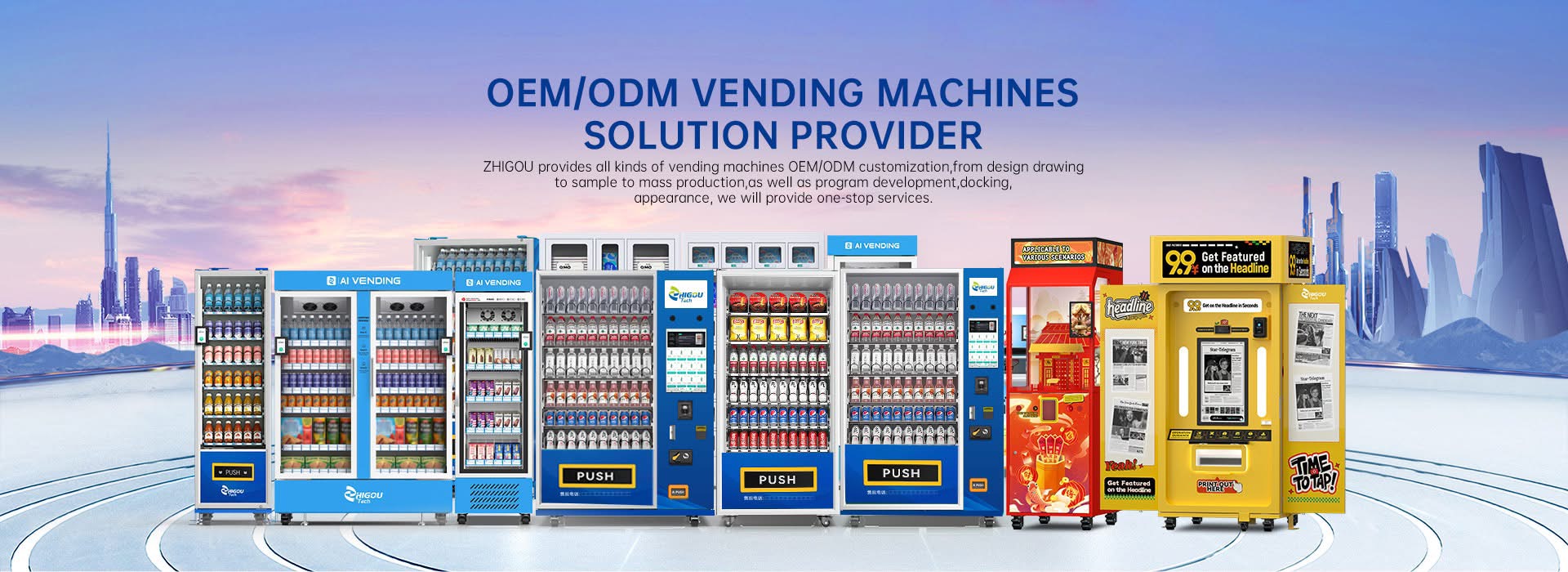
Commercial vending machines operate 24 hours a day, 365 days a year—combining heavy-duty sheet-metal enclosures, thermal insulation, refrigeration modules, motorized dispensing mechanics, cashless payment terminals, and cloud telemetry into a single unattended retail system. For B2B buyers, distributors, and operators evaluating equipment suppliers, understanding how vending machines are made makes it much easier to separate vertically integrated vending machine manufacturers from simple assembly workshops or trading companies.
Behind every reliable snack machine, elevator-delivery unit, or AI vision smart cooler lies a tightly sequenced industrial workflow that starts with the actual merchandise rather than the outer cabinet. Drawing on real production data from Xi'an Zhigou Intelligent Technology Co., Ltd. (Zhigou Tech)—whose 12,000-square-metervending machine factory tracks every build through 37 precision manufacturing processes, 126 quality inspection items, and MES (Manufacturing Execution System) batch traceability—this guide walks through each stage of commercial production in plain English.
1. Product-First Engineering Design and Bill of Materials (BOM) Planning
Before a single sheet of steel is cut, mechanical and electrical engineers translate the customer's merchandise and site requirements into 3D CAD drawings, sheet-metal unfolding blueprints, thermal airflow layouts, and a locked Bill of Materials (BOM). Experienced vending machine manufacturers design from the product outward: two boxes with identical outer measurements can behave differently on a shelf if one has glossy coated paperboard and another has textured cardboard, while flexible pouches expand under compression and narrow-neck bottles sit differently from straight-walled cans.
Modern modular engineering breaks a cabinet down into standardized subassemblies paired with customizable modules (for example, Zhigou Tech structures its platforms around 23 standard modules and 11 customizable modules) so custom configurations remain repeatable in batch production. At this stage, engineers finalize four core parameters:
Merchandise-to-Lane Fit: Measuring exact package width, height, depth, weight, rigidity, and fragility to set lane widths, shelf vertical spacing, spiral pitches, or elevator/locker tray clearances.
Cabinet Ergonomics & Serviceability: Ensuring repeatable mounting points, clear internal cable routing, easy technician access to service panels, and 2010 ADA reach-range compliance (keeping touchscreens, buttons, and card readers between 15 and 48 inches above the floor).
Electrical & Regional Standards: Matching local voltage and frequency (such as 110V–120V / 60Hz for North America vs. 220V–240V / 50Hz for Europe, Australia, and Asia), wire-gauge ratings, and safety certifications such as UL 751, CE / IEC 60335-2-75, and NSF/ANSI 25.
Dispensing & Connectivity Architecture: Selecting spiral coils, pushers, motorized elevators, lockers, or AI vision/weight shelves, alongside touchscreen UI languages, payment interfaces, and 4G/Wi-Fi telemetry.
2. Vending Machine Materials: Laser Cutting, CNC Bending, and Welding
Choosing the right vending machine materials sets the structural durability baseline from day one. A reputable vending machine factory sources prime metal coils—such as SPCC cold-rolled steel, galvanized steel, stainless steel, or aluminum profiles—with strict thickness tolerances (within ±0.1 mm on incoming coils) and QR-coded batch traceability from raw material warehousing through final dispatch.
Laser Cutting & CNC Forming: Automated laser cutters and precision press brakes shape flat steel blanks with sub-millimeter accuracy and optimized nesting layouts (achieving 92% material utilization on Zhigou Tech's cutting lines), while experienced sheet-metal technicians fine-tune complex multi-angle door-frame bends to account for batch elasticity so doors seal cleanly.
Targeted Welding & Stress Control: Leading vending machine manufacturers match the welding method to each structural role—using automated gas-shielded welding on main cabinet frames for seam consistency, manual argon-arc welding on heavy-load door hinges for maximum strength, and laser welding on visible exterior joints for a clean surface finish. Controlled weld sequencing keeps structural deformation within 1.5 mm/m so doors remain aligned after years of repeated opening and closing.
3. Surface Pretreatment, Electrostatic Powder Coating, and OEM Branding
Bare steel exposed to refrigeration condensation or humid public locations will corrode quickly without industrial surface finishing. Before coating, welded cabinets pass through multi-stage chemical pretreatment—degreasing, nano-ceramic conversion pretreatment, and pure-water rinsing—to remove mill oils and create a uniform microscopic bonding layer without heavy metals.
Next, electrostatic spray lines apply thermoset polyester or epoxy-polyester powder coatings, followed by high-temperature oven curing (around 190°C for 20 minutes, achieving a 2H pencil hardness finish). For harsh outdoor, coastal, or industrial environments, a specialized vending machine factory applies extra-thick-build anti-corrosion coatings on vulnerable edges and bases, verifying dry-film thickness with coating gauges (≥80 µm overall average and ≥120 µm on critical areas, rated for 1,000+ hours of salt-spray resistance). Custom brand colors, decals, and full-cabinet vinyl wraps are applied once the cured finish passes inspection.
4. High-Density Polyurethane Foaming for Thermal Insulation
For refrigerated beverage machines, fresh-food cabinets, ice cream freezers, and AI smart coolers, thermal insulation vending machine materials directly determine daily electricity consumption and compressor lifespan.
Double-walled cabinet shells are locked inside heavy hydraulic foaming jigs to prevent wall bulging under pressure, then injected with high-density polyurethane (PU) foam. Once cured, the closed-cell foam creates a seamless thermal barrier that locks in cold air, prevents exterior sweating, and adds structural rigidity to the cabinet body.
5. Modular Subassembly: Refrigeration, Dispensing Mechanics, and Doors
Rather than building everything piece by piece from scratch on a single slow line, efficient vending machine manufacturers pre-assemble major functional modules in parallel before integrating them into the insulated cabinet:
Assembly Subsystem
Key Components Installed
Why Manufacturing Precision Matters
Refrigeration Module
Commercial compressor, evaporator/condenser coils, expansion valve, circulation fans, and drain pan
Proper brazing, vacuum evacuation, and refrigerant charging prevent leaks and ensure fast pull-down cooling
Dispensing & Shelf Mechanics
Adjustable trays, spiral motors, elevator rails, optical drop sensors, or load-cell weight shelves
Accurate alignment and sensor calibration prevent jammed items and double-vends
Insulated Glass Door
Multi-pane tempered or Low-E heated glass, dual magnetic gaskets, and anti-pry locks
Laser-leveled installation and tight magnetic seals (≤0.3 mm gap variance) stop condensation and warm-air leakage
During final mechanical assembly, calibrated torque wrenches (with preset torque values for door hinges, compressor mounts, and shelf rails) ensure every fastener meets exact mechanical specs without stripping threads or loosening during freight transit.
6. Control Board, Wiring Harness, and Cloud Software Integration
Modern automated retail units are as much embedded computing devices as mechanical cabinets. An organized vending machine factory builds modular, color-coded wiring harnesses with flame-retardant sleeving and locking connectors—allowing technicians to connect major electrical subsystems cleanly while reducing wiring errors and simplifying future field servicing.
At the electrical integration station, technicians mount the main control board (VMC), power supply unit, touchscreen display, LED lighting drivers, and MDB/DEX payment interfaces for cashless card readers, mobile wallets, or bill/coin acceptors. For smart cabinets and AI coolers, engineers also install interior vision cameras, door-status switches, and 4G/Wi-Fi telemetry modules, flashing regional firmware and binding each unit's serial number to the cloud Vending Management System (VMS) for remote inventory, temperature, and sales management.
7. Burn-In Testing, Real-Product Trials, and Export Crating
Reputable vending machine manufacturers never ship a unit straight off the assembly line without powered endurance testing and real-product verification. Finished cabinets pass through a multi-stage Factory Acceptance Test (FAT) before crating:
Electrical Safety & Airtightness Checks: Verifying grounding continuity, insulation resistance, safe operation under rated voltage, and door-seal airtightness.
Extended Powered Burn-In & Thermal Stress Testing: Running machines under power—including 48-hour continuous powered aging and -10°C to 45°C environmental temperature cycling—to catch early electronic drift, verify cooling pull-down speed, and test automated Health-Lock temperature cutoffs.
Real-Product Vend Testing & Inspector Sign-Off: Running hundreds of repeat dispensing cycles across lanes using actual sample packages, simulating payment authorizations and failed-vend refunds, and completing a final hands-on check by senior quality inspectors before issuing a serial-numbered test record.
Protective Export Crating: Securing internal trays and moving mechanisms with custom foam/steel bracing, wrapping the cabinet in moisture-barrier film, and sealing it inside a reinforced, ISPM-15 fumigated plywood crate (or heavy-duty carton with corner guards and wooden skids for domestic/regional transit) fitted with tilt and shock indicators.
8. Why Vertically Integrated Production Matters for B2B Buyers
When comparing vending machine manufacturers, how much of the production workflow happens inside one vending machine factory directly determines build consistency, customization speed, and long-term spare-parts compatibility. Suppliers that piece together outsourced steel shells, generic third-party controllers, and disconnected software often struggle to resolve cross-system glitches or supply matching components years later.
A vertically integrated manufacturer—such as Zhigou Tech at its Xingtai, Hebei production base, where in-house sheet-metal fabrication, foaming, refrigeration assembly, and 37-step / 126-item QA testing are paired with proprietary control board and VMS cloud software R&D—can tailor cabinet layouts, dispensing mechanisms, electrical specs, and software features directly to a buyer's project requirements while maintaining full batch traceability.
Frequently Asked Questions
What vending machine materials are used in commercial cabinets?
Most commercial vending machine materials include cold-rolled steel (such as SPCC) or galvanized steel finished with baked powder coating, paired with high-density polyurethane (PU) foam insulation and multi-layer tempered or Low-E glass doors.
How long does it take a vending machine factory to build an order?
For standard or lightly customized models, production and testing inside a vending machine factory typically take 15 to 30 days, depending on order volume, seasonal schedules, and custom cabinet, software, or payment hardware requirements.
What quality tests should vending machine manufacturers run before shipping?
Reliable vending machine manufacturers run electrical safety checks, extended powered burn-in and refrigeration pull-down tests, repeated real-product dispensing and sensor checks across shelves, and payment/telemetry verification before export crating.
Why does understanding how vending machines are made help B2B buyers?
Knowing how vending machines are made helps buyers verify whether a supplier controls sheet-metal quality, insulation thickness, control board R&D, and powered burn-in testing—reducing downtime and maintenance costs over the machine's service life.