Starting a vending machine business can be an attractive way to enter the self-service retail industry. However, before purchasing your first machine, choosing a location, or signing agreements with property owners, you should consider how your business will be legally structured.
For many first-time vending machine operators in the United States, two common options are a sole proprietorship and a Limited Liability Company (LLC). Both structures can work for a vending business, but they differ significantly in personal liability, administration, taxation, and long-term business planning.
So, is an LLC better than a sole proprietorship for a vending machine business? There is no single answer for every operator. The right choice depends on your business size, risk exposure, growth plans, state requirements, and tax situation.
Note: This article provides general educational information, not legal or tax advice. Business formation, licensing, liability, and taxation rules vary by state. Consult a qualified attorney, accountant, or business advisor for advice based on your specific situation.
What Is a Sole Proprietorship?
A sole proprietorship is one of the most basic company forms in the US. You may often be working as a sole proprietor if you carry out business operations without registering as another kind of business company.
This could entail you buying and running many automatic vending machines, managing merchandise, negotiating placements, collecting money, and paying for business expenditures.
Simplicity is one of the main benefits. Compared to an LLC, a single proprietorship typically has fewer creation procedures, and the individual retains direct control over the company. According to the SBA, sole proprietorships may be appropriate for entrepreneurs who wish to run a relatively low-risk business or test a business idea.
Nevertheless, one crucial point to keep in mind is that a sole proprietorship does not establish a distinct legal entity between the individual and the company. Generally speaking, an owner's personal assets and liabilities are not legally distinct from those of their vending business. Because of this, the owner could be held personally responsible for the commitments and debts of the company.
A sole owner typically reports business income and expenses on Schedule C (Form 1040) for federal tax reasons. Self-employment tax is often calculated using Schedule SE if net earnings from self-employment are $400 or higher.
What Is an LLC?
An LLC, or Limited Liability Company, is a business entity created under state law. It can have one or more owners, known as members.
For an automatic vending machine operator, forming an LLC can create a formal legal structure for the business and generally provides limited liability protection to the owners, subject to applicable law and the circumstances of a particular claim.
The SBA explains that LLCs generally protect owners from personal liability in most instances, helping separate personal assets from business liabilities. However, an LLC should not be viewed as absolute protection from every possible claim or obligation.
LLCs can also offer flexibility in how they are taxed. For federal income tax purposes, a single-member domestic LLC is generally treated by the IRS as a disregarded entity unless it elects corporate treatment. A multi-member domestic LLC is generally treated as a partnership unless it makes an election to be treated as a corporation.
LLC vs. Sole Proprietorship for Vending Machines
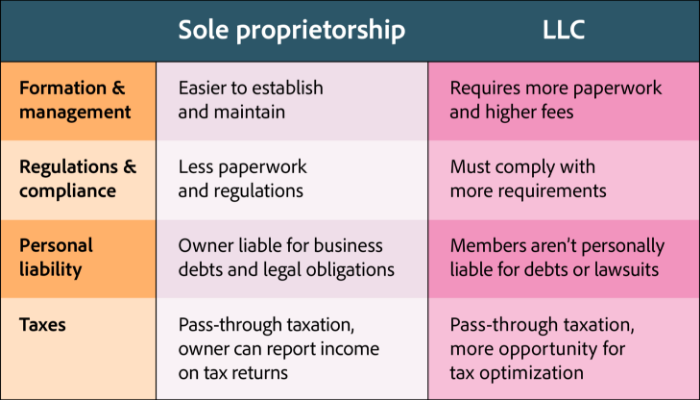
The following comparison provides a general overview:
Factor | Sole Proprietorship | LLC |
Setup | Generally simple | Requires state formation |
Ownership | One owner | One or more members |
Separate legal entity | No | Yes |
Personal liability | Generally unlimited | Generally limited, subject to exceptions |
Administrative requirements | Usually simpler | Generally more formal |
Federal tax treatment | Generally reported by the owner | Depends on LLC classification/election |
Self-employment tax | Generally applies | May apply depending on tax classification |
Business growth | Suitable for smaller operations | Often attractive for businesses planning to scale |
State fees | Generally lower or simpler | Varies by state and may include formation/ongoing fees |
Business structure | Informal | Formal legal entity |
Liability Protection: One of the Most Important Differences
The degree of separation between the vending business and the owner is one of the most significant distinctions between an LLC and a sole proprietorship. The person and the company are typically not distinct legal entities in a sole proprietorship. This implies that the owner's personal assets may be more vulnerable to corporate liabilities if the automatic vending machine company encounters certain debts, claims, or legal problems.
Because self-service vending machines are actual pieces of equipment placed in public or commercial spaces, this consideration may be especially pertinent to those who operate them. Potential risks could include customer injuries, equipment malfunctions, electrical problems, water leaks, refrigeration issues, product-related claims, property damage, or contractual conflicts, depending on the items, equipment, and working environment.
An LLC, on the other hand, is a formal business entity created under state law and generally provides limited liability protection to its owners, subject to applicable laws and exceptions. This legal separation can help distinguish the business's liabilities from the owner's personal assets. However, an LLC should not be viewed as absolute protection. Proper business practices, financial separation, compliance, contracts, and appropriate commercial insurance remain important regardless of the business structure.
For a small vending machine business with very limited operations, a sole proprietorship may be sufficient for getting started. For operators who are building a larger vending business and are particularly concerned about separating business liabilities from personal assets, an LLC may provide a more appropriate long-term structure.
Startup Simplicity and Administrative Requirements
The difficulty of starting and running a firm is another significant distinction. Generally speaking, one of the easiest business structures to run is a single proprietorship. Obtaining the necessary municipal licenses or permissions, buying vending equipment, finding a suitable location, stocking merchandise, setting up payment processing, and getting the right insurance are all possible steps for a new self-service vending machine operator. Depending on the state and municipality, different requirements apply.
An LLC requires a more formal setup process. Depending on the state, the owner may need to file formation documents, pay state registration fees, maintain company records, and submit annual or periodic reports. Some states also impose ongoing fees or taxes on LLCs. These requirements mean that an LLC typically involves more administrative responsibilities than a sole proprietorship.
For entrepreneurs who are simply testing the vending business with a small number of self-service vending machines, the simplicity of a sole proprietorship can be attractive. However, operators who already know they want to start a long-term vending business may decide that the additional administrative requirements of an LLC are worthwhile because they provide a more formal business structure.
Business Credibility and Vending Machine Location Agreements
Location selection is one of the most important factors in the success of vending machine businesses for sale. As an operator grows, the business may move beyond small private locations and begin targeting shopping malls, office buildings, hotels, gyms, schools, hospitals, transportation facilities, and other commercial properties.
These locations may require formal placement agreements, proof of insurance, business information, revenue-sharing arrangements, and clearly defined responsibilities for maintenance and service. A sole proprietor can enter into these types of agreements, so an LLC is not necessarily required simply because a business works with commercial locations.
However, operating through an LLC can give vending machine businesses for sale a more formal corporate identity. This may help establish credibility when communicating with property managers, commercial partners, suppliers, financing companies, and other business organizations. An LLC does not guarantee access to better vending locations, but having a formal business structure can make the overall operation appear more established and organized.
For a vending machine operator who is managing several locations and regularly negotiating formal placement agreements, an LLC may therefore be more suitable than remaining a sole proprietor indefinitely.
Which Is Better for a Vending Machine Business?
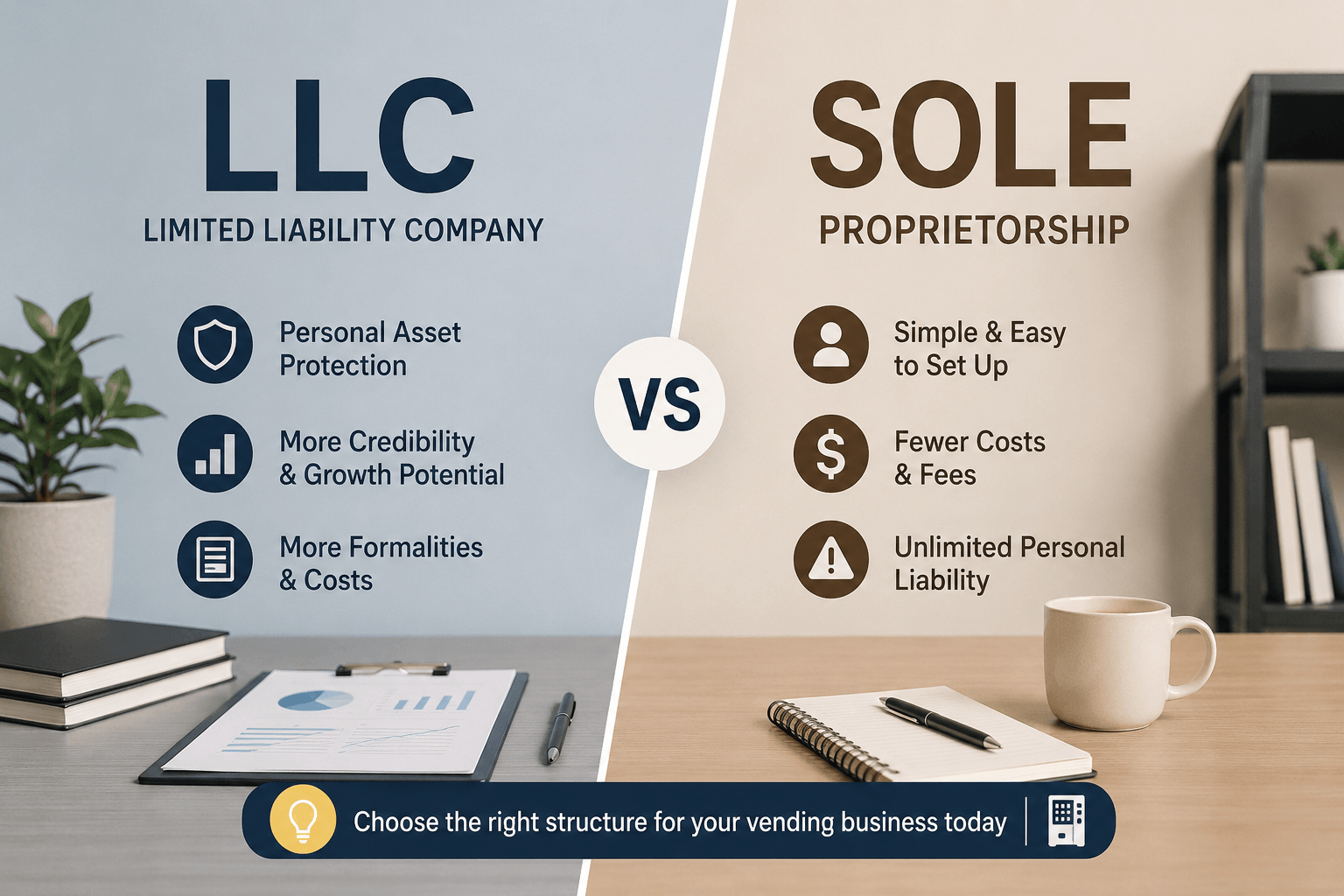
There is no universal “best” structure. Your choice should reflect your current business situation and future plans.
A Sole Proprietorship May Make Sense If:
· You are testing the vending machine business.
· You operate only a small number of machines.
· You want a simple business structure.
· You want to minimize administrative complexity.
· Your business is relatively small, and you understand the personal liability implications.
The SBA notes that sole proprietorships can be appropriate for owners who want to test a vending business idea or operate a relatively low-risk vending business.
An LLC May Make Sense If:
· You plan to operate multiple automatic vending machines.
· You are starting a long-term vending business.
· You regularly enter into contracts with property owners or businesses.
· You want a formal business entity.
· You want the potential liability protection associated with an LLC.
· You plan to expand vending machine businesses for sale or bring in additional owners.
For a growing vending operation, an LLC can provide a more formal structure while generally offering liability protection that a sole proprietorship does not provide.
Conclusion
There are other factors to consider while deciding between an LLC and a single proprietorship. The current state of your vending business and your future goals will determine which option is best. A sole proprietorship might be a sensible place to start if you are starting with a small number of machines and wish to explore locations, products, and revenue possibilities with little administrative complexity. But if your company expands, an LLC might be a better option due to things like liability protection, commercial contracts, financial separation, staff, various locations, and long-term growth.
In the end, your company's structure should encourage expansion rather than restrict it. As your vending business grows, reevaluate your alternatives, keep accurate insurance and financial records, and start with a structure that fits your current needs. Having the proper structure, dependable equipment, lucrative locations, and efficient operational management can create a stronger basis for long-term success, regardless of whether you are starting your first vending machine or developing a multi-location vending business.
Ready to Start Your Vending Machine Business?
Once you have chosen the right business structure, the next step is selecting the right vending machines for your target locations and products. From traditional spiral vending machines to AI vision vending cabinets and specialized self-service solutions, choosing the right equipment can make a significant difference in your operational efficiency and customer experience.
FAQ
Do I need an LLC to operate a vending machine business?
No. An LLC is not universally required simply because you operate vending machines. Depending on your situation, you may operate as a sole proprietor or choose another business structure. However, you may still need applicable licenses, permits, registrations, and insurance.
Is an LLC better for a vending machine business?
An LLC may be attractive for operators who want a formal business structure and potential limited liability protection. However, a sole proprietorship may be simpler for someone testing a small business. The right choice depends on your circumstances.
Does an LLC completely protect my personal assets?
No. An LLC generally provides limited liability protection, but it should not be considered absolute protection. Insurance, contracts, proper recordkeeping, and compliance remain important.
Does an LLC automatically reduce taxes?
No. A single-member LLC is generally treated as a disregarded entity for federal income tax purposes unless it elects another classification. Its income is generally reported by the owner, and self-employment tax can apply.
Can I change from a sole proprietorship to an LLC later?
Generally, yes, but the process and tax consequences can vary by state and situation. Check applicable state requirements and consult a qualified professional before restructuring.
Do vending machine businesses need insurance?
Insurance requirements depend on the business, location, products, and applicable laws. Even where particular coverage is not legally mandated, appropriate insurance may be an important part of managing business risk.
Reference
Vendsoft. (2026, May 21). LLC vs Sole Proprietorship for vending machines. vendsoft.com
Everesticeandwater. (2023, September 28). LLCs vs. Sole Proprietorship: Which Should I Choose?. everesticeandwater.com