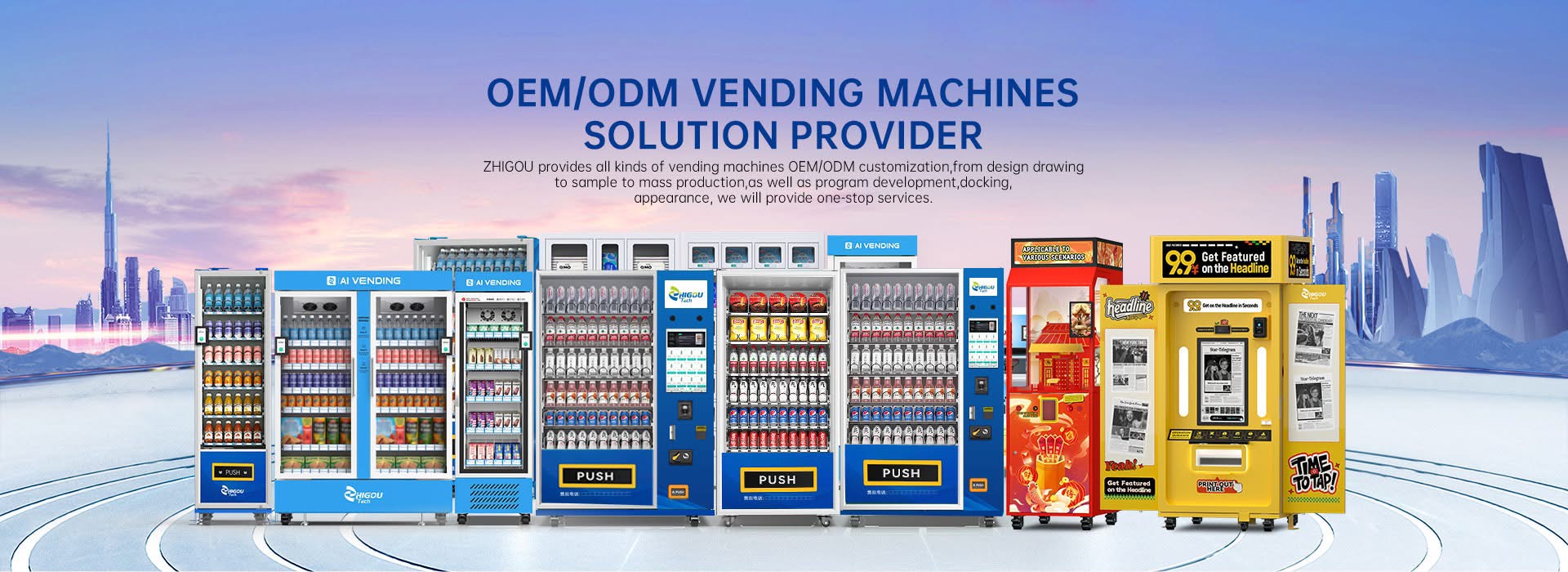
Spiral vending machines are a classic model widely used in the unmanned retail sector with proven technology. Thanks to their reliable dispensing mechanism and controllable operating costs, they are extensively deployed in various unmanned settings, such as campuses, factories, office buildings, and industrial parks. The following section will objectively analyze the practical advantages and inherent limitations of Zhigou spiral vending machines, starting with their mechanical composition and complete operating principles. It will also introduce the classification of Zhigou Technology’s mainstream best spiral vending machine models, key practical points for product placement, and a special custom model—the spring-loaded cabinet with an external display—to help partners gain a comprehensive understanding of the products and select the vending equipment best suited for their projects.
1. Spiral Mechanism Composition and Operating Principle
1.1 Composition:
The system consists of the monitoring unit, foam-insulated chamber, base, control cabinet, door assembly, refrigeration unit, inventory storage and dispensing system, display screen, mainboard, LED strip lights, electrical controls, wiring harness, payment system, and other components.
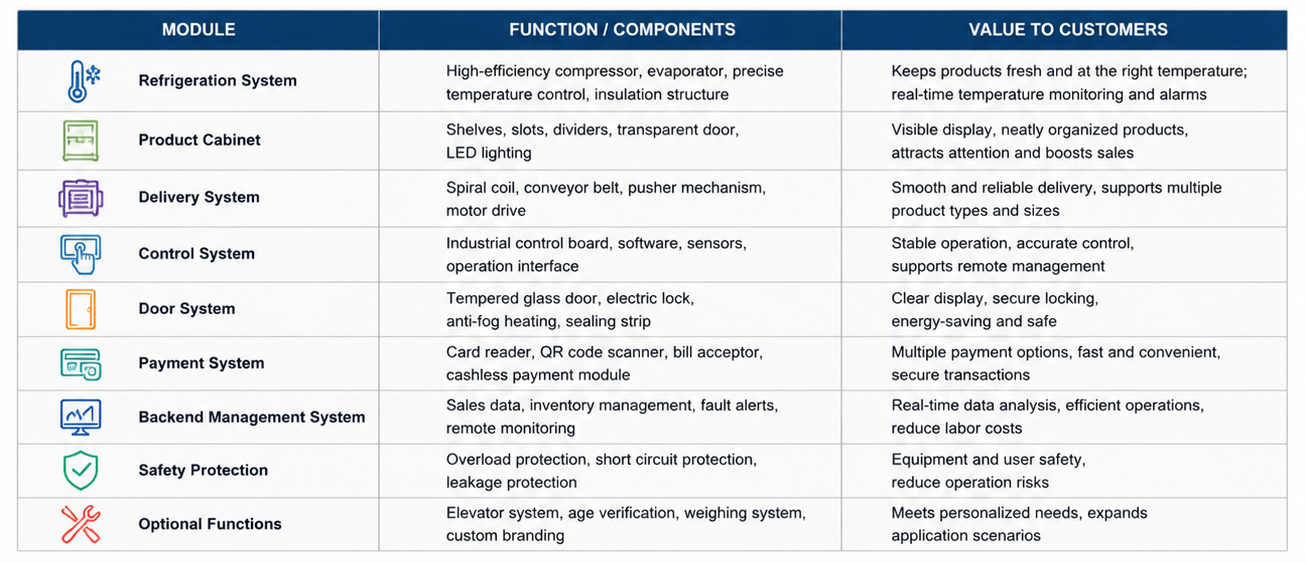
Monitoring: Top order display and order display in the lower-right corner of the 10.1-inch screen
Foam-Insulated Chamber: Consists of an inner liner, outer shell, embedded fittings, and insulation layer. (All insulation layers from Zhigou Technology are made of one-piece foam.)
Base: Consists of a base frame, swivel casters, leveling legs (T-shaped legs), and L-shaped brackets.
Control Cabinet: Varies by model; some include it, while others do not. Models without a control cabinet are designed for external display screens.
Door Assembly: Consists of a door frame, double-pane insulated glass (argon-filled), an electric heating system, a retrieval chute, and locks.
There are two types of door frames: one is an aluminum alloy door frame (with an anodized surface finish, commonly used in domestic models); the other is a sheet metal door frame with a powder-coated finish. Locks come in two types: T-shaped locks and top-and-bottom locks. The retrieval hopper consists of the hopper body, anti-theft partition, push plate, and product drop detection assembly (product drop detection is optional).
Refrigeration Unit: Includes the compressor, condenser, fan, drain pan, evaporator, and piping. Compressor brand: Wanbao. Cooling method: Air-cooled; the advantage is that it does not form frost. The evaporator and condenser are made of aluminum. The connecting pipes are copper. The cooling range is 4–10°C. Refrigerant type: propane (R290, approximately 50–60 g), which offers two major advantages: energy efficiency and environmental friendliness.
Foam-insulated cabinet panel thickness: outer panel 0.5 mm; inner panel (embossed) 0.23 mm (all models feature foam-insulated cabinets).
Spring Machine – Base Sheet Metal: 1.5 mm galvanized sheet metal / square tubing with powder coating; outdoor-grade powder coating is used;
Spring Cabinet—Control Cabinet Enclosure: 1.2 mm galvanized sheet metal with powder coating; indoor-grade powder coating used
Spring Cabinet—Control Cabinet Door: 1.5 mm galvanized sheet metal with powder coating; indoor-grade powder coating used
Spring Cabinet – Trays: 0.8 mm galvanized sheet metal with powder coating; indoor-grade powder coating used
Insulation Layer: Foam material is cyclopentane (environmentally friendly material); total insulation thickness 40 mm; density 30–35 kg/m³
Light strips: Consist of 2 milky white LED tubes, each 1.2 m long.
Electric heating method: PTC heating strips; power: 500 W; heating range: 24–30 °C; advantages: low thermal resistance, high heat exchange efficiency, excellent thermal conductivity and heat dissipation performance, safe and reliable.
Glass: Yuebang brand glass is used; you can check the Guinness World Records for more information. Electric heating method: PTC heating strips, power: 500 W, heating range: 24–30 °C. Advantages: low thermal resistance, high heat exchange efficiency, excellent thermal conductivity and heat dissipation performance, safe and reliable.
Screen: Zhigou spiral vending machine’s capacitive touchscreen with built-in Android 7.1 operating system. Resolution for 8-inch and 10-inch screens: 1280×800; resolution for 15.6-inch screens: 1366×768; resolution for 21.5-inch screens and larger: 1920×1080
Storage and Dispatch System: Comprises ladder racks, pallets, springs (retention slots), dividers, motors, wiring harnesses, and drop detection. Ladder racks are adjustable in 2 cm increments.
Spring wire diameter: 4 mm. Classified by the number of retention slots: 3, 4, 5, 10, 15, and 20 slots.
Conveyor Types: Spring conveyors, belt conveyors, and hook conveyors. Common spring conveyor configurations include 10×5 single-lane, 9×5 single-lane, 8×4 single-lane, 10×7 single-lane, 10×10 single-lane, 5×3 double-lane, 5×5 double-lane, and 5×7 double-lane; Track-type chutes are available in single-chute and dual-chute configurations, with no slot restrictions; hook-type chutes come in 10-hook and 20-hook variants, billed per unit, and accommodate products of varying widths based on the spacing between hooks, with shelf height determined by product height.
Partition panels for export models are made of sheet metal, while domestic models use injection-molded partitions; the thinner sheet metal construction reduces the likelihood of product jamming.
Electrical Control Components: These include: circuit breakers, defogging switches, 12V power supply, 24V power supply, motor driver board, and refrigeration and lighting control board.
1.2 How the Spiral Vending Machine Works?
After the customer selects an item on the screen, the commercial spiral vending machine displays payment options. The customer selects a payment method and completes the transaction. The system then sends a command to the motor, which drives the spring to rotate one full turn; the best spiral vending machine pushes the item down into the dispensing slot.
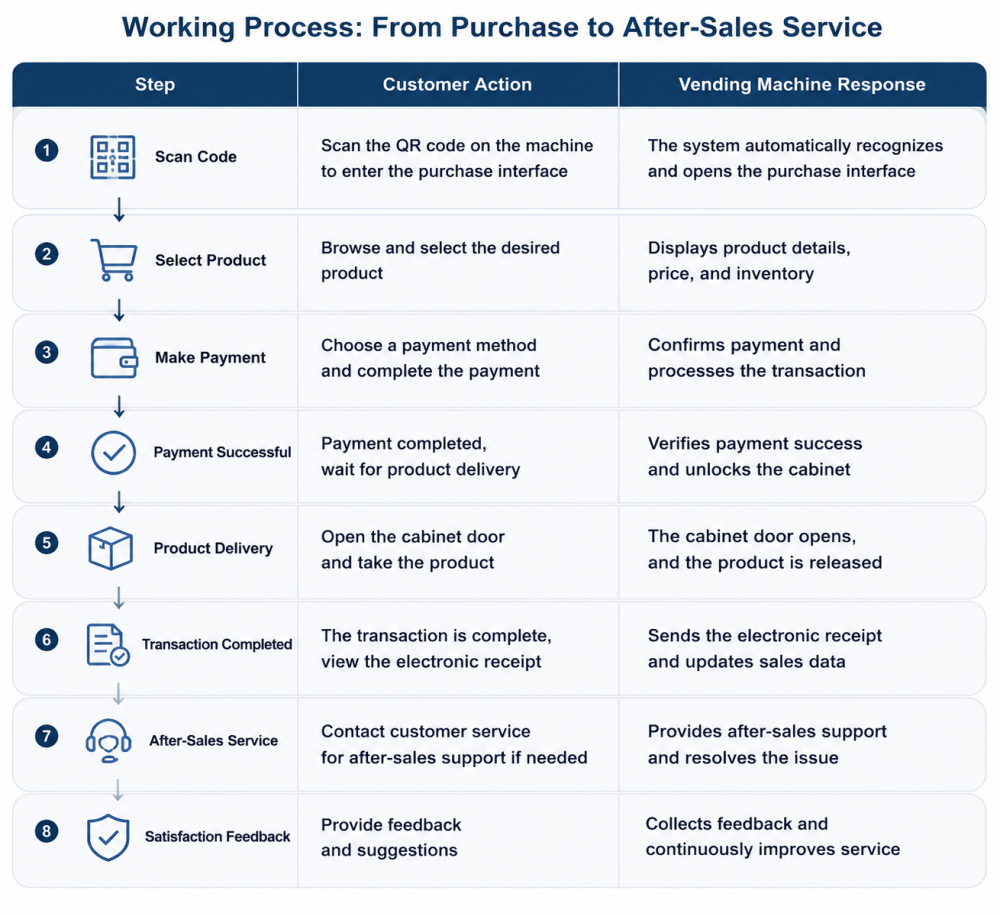
1.3 Software Components
Front-end (vending machine side) and back-end. The back-end is further divided into mobile and PC versions. The back-end consists of our proprietary SaaS cloud-based management system, which allows users to view vending machine status, sales data, and more.
2. What are the Advantages and Disadvantages of Spiral Vending Machines?
Zhigou spiral vending machines feature mature and stable technology, offering core advantages such as a low product loss rate, controllable security for both funds and merchandise, and outstanding value for money. The machines operate on a “pay first, then dispense” logic, preventing consumers from directly accessing all items inside the cabinet. All orders and sales data are stored on the backend, making them ideal for unattended settings with strict location management requirements—such as schools, factories, and offices—as well as for projects involving initial deployment, limited budgets, and the sale of standard product categories.
At the same time, commercial spiral vending machines have certain objective limitations: due to the structure of the product channels, there is a risk of product jams if the product dimensions, placement angles, or channel configuration are mismatched; compatibility is also limited for oversized items, fragile goods, soft-packaged items, and irregularly shaped products. We can mitigate the risk of product jams by selecting appropriate product channels, standardizing product placement, and conducting preliminary test sales. If the product range is complex and diverse, we can also recommend alternative models—such as AI-powered door-opening lockers, compartment lockers, or conveyor-belt channels—to meet different retail needs.
3. Common Classifications of Zhigou Spiral Vending Machines
2.1 In terms of structure, Zhigou spiral vending machines are classified into conventional spiral machines (with control cabinets), conventional auxiliary cabinets, and spiral machines with external control panels.
2.2 In terms of temperature control, Zhigou spiral vending machines are classified into three types: refrigeration machines, refrigeration-heating machines, and ambient-temperature machines. Generally, the main units come with refrigeration functionality; a small number of customers require refrigeration-heating machines or ambient-temperature machines. Most “one-to-one” auxiliary cabinets are ambient-temperature machines.
2.3 Zhigou spiral machines are classified by touchscreen size and number of lanes as follows:
55-inch screen, 60 lanes
21.5-inch screen, 60 lanes
15.6-inch screen, 60 lanes
10.1-inch external screen, 60 lanes
10.1-inch screen, 36 lanes
8-inch screen, 36 lanes with side cabinet (export model)
10.1-inch external screen, 60 product slots (export model)
8-inch external screen, 36 product slots (export model)
External full-screen card reader, 60 product slots (export model)
External full-screen card reader, 36 product slots (export model)
As well as corresponding combination cabinet models; the auxiliary cabinets of combination cabinets can be paired with either commercial spiral vending machine auxiliary cabinets or grid-style auxiliary cabinets
4. Zhigou Spiral Machine Precautions
4.1 The total interior height of a commercial spiral vending machine is 1,300 mm.
4.2 Based on a standard 60-lane cabinet
with standard water and beverage loading: the machine has 6 layers, each layer has 10 lanes, and each lane holds 5 bottles (i.e., 10 × 5 single lanes); each layer holds a total of 50 bottles, and the entire machine holds a total of 300 bottles.
4.3 Bucket-style products: One layer consists of 5 product slots, with 3 buckets per slot (i.e., 5 × 3 double-slot configuration), totaling 15 buckets with a height of 220 mm.
4.4 Puffed snacks such as potato chips and other thicker snacks: One layer consists of 5 product slots, with 5 bags per slot (i.e., 5 × 5 double-slot configuration), totaling 25 bags with a height of 220 mm or 200 mm.
4.5 Betel nuts, sunflower seeds, peanuts, crispy noodles, etc.: One layer consists of 5 lanes, with 7 packs per lane (i.e., 5 × 7 double lanes), for a total of 35 packs, with a height of 220 mm or 200 mm.
4.6 For individual sausages, playing cards, etc.: One layer consists of 10 aisles, with 10 items per aisle (i.e., 10×10 single aisles), totaling 100 items per layer, with a height of 180 mm.
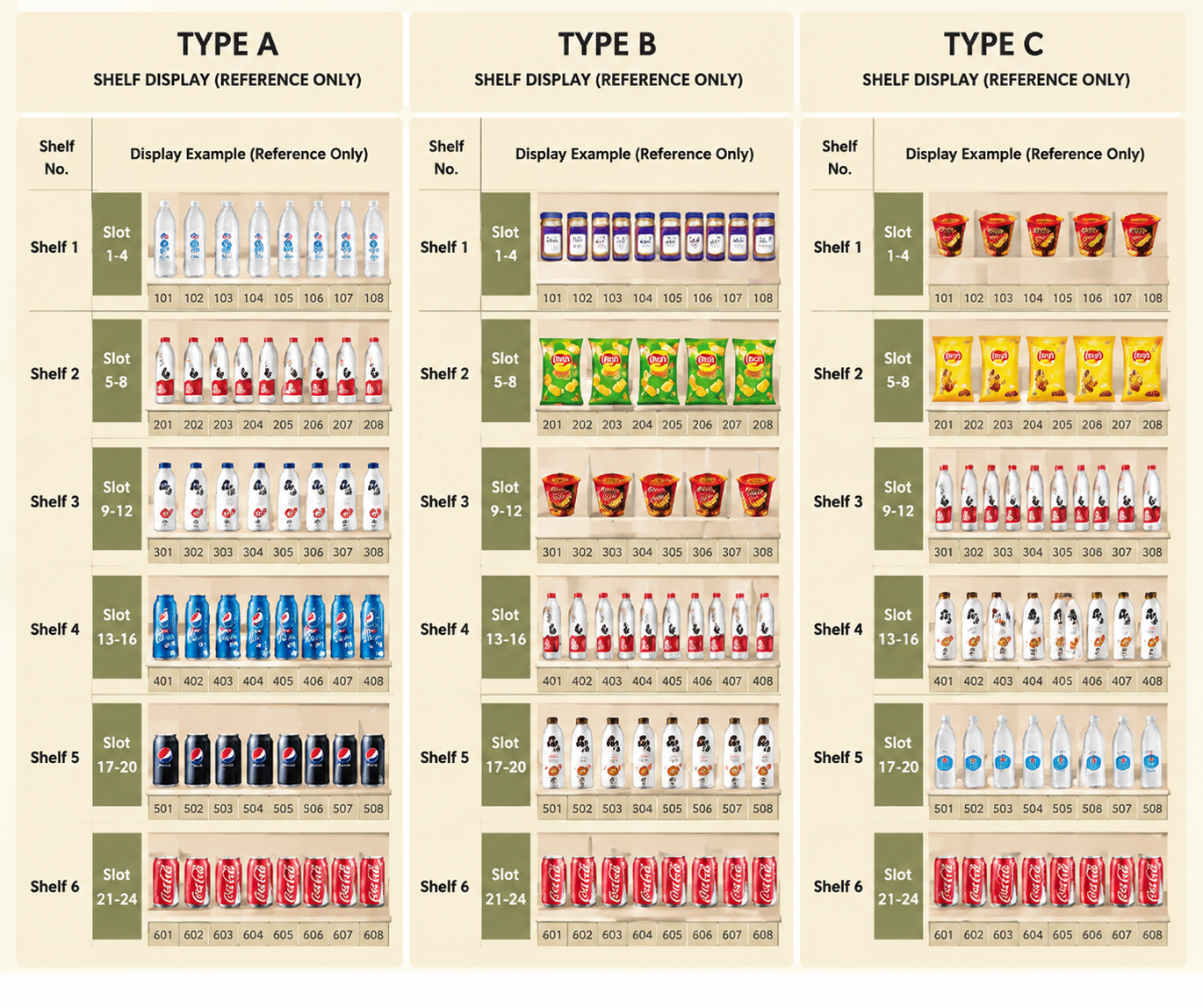
Currently, there are three commonly used shelf configurations: Type A, Type B, and Type C (as shown in the figure).
Type A: Levels 1–3: 10×5 single-aisle layout for standard 500-ml beverages; Level 4: 9×5 single-aisle layout for 600-ml beverages such as Mijia and Nutrition Express; Levels 5–6: 10×5 single-aisle layout for canned beverages.
Type B: Level 1 features 10×5 single-lane slots for playing cards, individual sausages, tissues, etc.; Level 2 features 5×5 double-lane slots for snacks; Level 3 features 5×3 double-lane slots for instant noodles in buckets; Levels 4–5 feature 10×5 single-lane slots for standard 500ml bottled beverages; Level 6 features 10×5 single-lane slots for canned beverages.
Type C: 1st layer: 5×3 dual-lane instant noodles; 2nd layer: 5×5 dual-lane snacks; 3rd–5th layers: 10×5 single-lane standard 500ml beverages; 6th layer: 10×5 single-lane canned beverages.
5. How to Properly Put Products on Spiral Vending Machine?
* Place lighter items on top and heavier items on the bottom. For example, place playing cards, snacks, and instant noodle cups on top, and beverages on the bottom (non-carbonated drinks on top, carbonated drinks on the bottom). Canned beverages should be placed at the very bottom (to prevent breakage during handling and to avoid spills when customers remove them).
*When arranging products on the shelves, place them continuously from front to back without leaving any gaps in the middle to prevent customers from having to scroll through empty spaces.
*Products should be uniformly tilted backward to facilitate smooth retrieval; they must not be tilted forward (as shown in the figure).
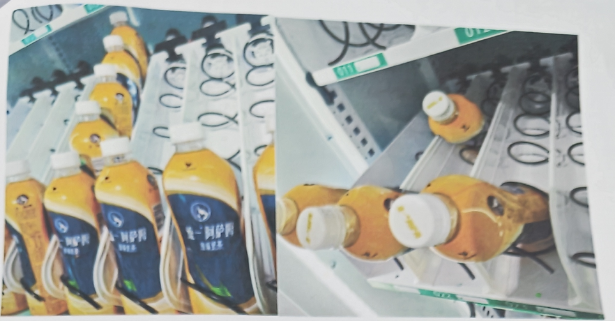
*Total pallet width: 770 mm; of which the effective width for a single aisle is 73 mm and for a double aisle is 150 mm.
6. External-Screen Spring Cabinet
The main cabinet body of the external-screen spiral cabinet is the same as that of a standard spring cabinet, except that the control cabinet has been removed and the screen is embedded into the door frame and glass. The lock mechanism has been replaced with a top-and-bottom locking system—advantages: compact size and affordable price.
Disadvantages: The external-screen spiral cabinet cannot be retrofitted with additional accessories; the screen has a lower resolution.
Conclusion
In summary, spiral vending machines feature a mature and reliable hardware solution. Still, their dispensing performance is closely tied to the selection of product chutes, product placement, and the types of items sold. Based on the types of products you sell, your deployment scenario, and your budget requirements, Zhigou Technology can match you with a standard spiral model or provide specialized equipment, such as a spiral cabinet with an external display. If you have a project in the planning stages, please feel free to contact us for model recommendations and a quote.