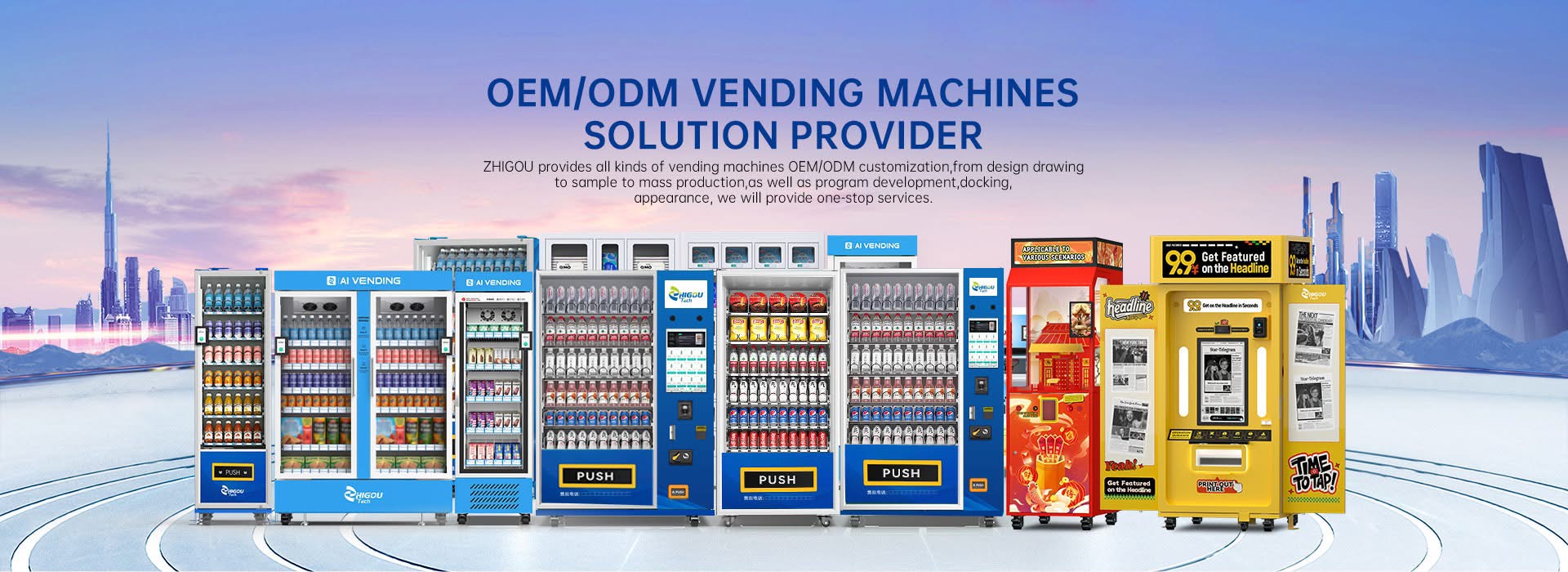
As the unmanned retail industry continues to evolve, AI-powered vending machines with their novel shopping mode of free pickup and automatic settlement upon closing the door have gradually become a popular device in commercial vending machines for sale nowadays. This article will comprehensively introduce the details of this intelligent vending machine from aspects such as its advantages and disadvantages, hardware structure, operation process, shelving standards, and risk matters.
1. Components of the AI-powered vending machine
The AI-powered vending machine mainly consists of monitoring components, foaming insulation box, base, door, refrigeration unit, storage layer rack, interactive screen, light strips, electrical control accessories, wiring harness, and the entire payment system.
Monitoring: top monitoring and internal AI recognition monitoring
Foaming box body: composed of inner liner, outer shell, embedded parts, insulation layer (all insulation layers of Zhigou Technology are of integrated foaming type)
Base: including base frame, swivel wheels, leveling supports, L-shaped brackets.
Door body: composed of door frame, double-layer central control glass (filled with argon gas in the middle), electric heating system, lock frame divided into aluminum-coated plastic, lock as self-developed middle-mounted lock.
The refrigeration unit includes a compressor, condenser, fan, water collection box, evaporator, piping, etc. Compressor brand: Wanbao. Refrigeration method: air-cooled; the advantage is that it is not prone to frosting. The evaporator and condenser materials are aluminum. The connecting pipe is a copper pipe. Refrigeration range: 4-10°C. Refrigerant model: propane (R290/Propane), with two major advantages of energy conservation and environmental protection.
Foaming box body sheet thickness: outer plate 0.5mm; inner plate (embossed) 0.23mm (all models of foaming box bodies)
Opening cabinet - sheet metal kit (light box, air inlet guard cover, middle column lock cover): 1.0mm galvanized sheet powder coating; spraying uses indoor plastic powder;
Single-door cabinet - base: 1.5mm galvanized sheet powder coating; spraying uses indoor plastic powder
Double-door cabinet - base: 2.0mm galvanized sheet powder coating; spraying uses indoor plastic powder
Insulation layer foaming material: cyclopentane (environmentally friendly material), total insulation layer thickness 40mm, density 30-35kg/m³
Light strips: 2 white LED tubes, each 1.2m long.
Electric heating method: PTC heating strip heating, power 500W, heating range 24-30°C, advantages: low thermal resistance, high heat exchange efficiency, good heat conduction, excellent heat dissipation performance, safe and reliable
Screen: capacitive touch screen, built-in Android system 7.1; also has a light board screen.
Storage and delivery system: ladder, shelves, gravity slide rail (optional), each grid of the ladder 2cm, adjustable.
The electrical control part is divided into: air switch, power control box, 12V power supply, refrigeration light control board.
Software part: front end (machine end) and back end. The back end is divided into mobile phone end and PC end. The back end is our self-developed SaaS cloud back-end management system, which can view the status of the AI-powered vending machine, sales data, etc.
2. How does the AI-powered vending machine work?
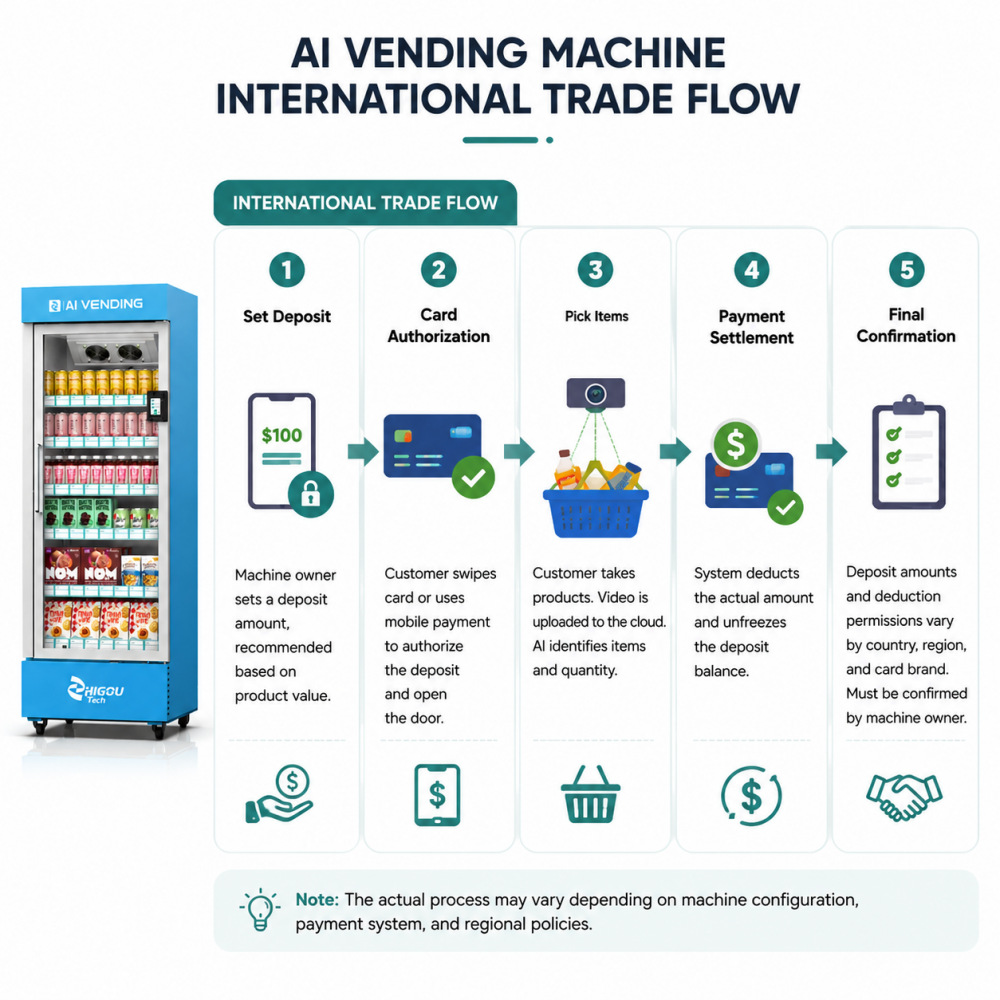
The foreign trade model uses pure vision + AI algorithm. Specifically: The owner of the intelligent vending machine first sets the pre-freezing amount (suggested around 30 US dollars). After the customer uses the card reader to freeze the corresponding pre-freezing amount and obtains authorization, the AI-powered vending machine opens the door. The customer takes the goods by themselves and closes the door. The AI vision vending machine starts recording the video from the moment it opens the door until it closes completely, uploads the video to the cloud, and the AI determines what goods the customer took and the quantity, and deducts the amount according to the machine's settings. Once the deduction is successful, the pre-freezing amount is unfrozen, and the transaction is completed. In case of an order that the AI cannot determine, it will be judged manually. If manual judgment is also unable to determine or if it is an unfriendly shopping situation, an abnormal order will be pushed to the machine owner's backend, and the machine owner will make the judgment by themselves. Note: Due to the uncertainty of the pre-freezing permissions and whether there is an additional permission for different countries and regions as well as different brands of card readers, it is necessary to confirm one by one.
3. Dimensions and Capacity of the Zhigou AI Vending Machine
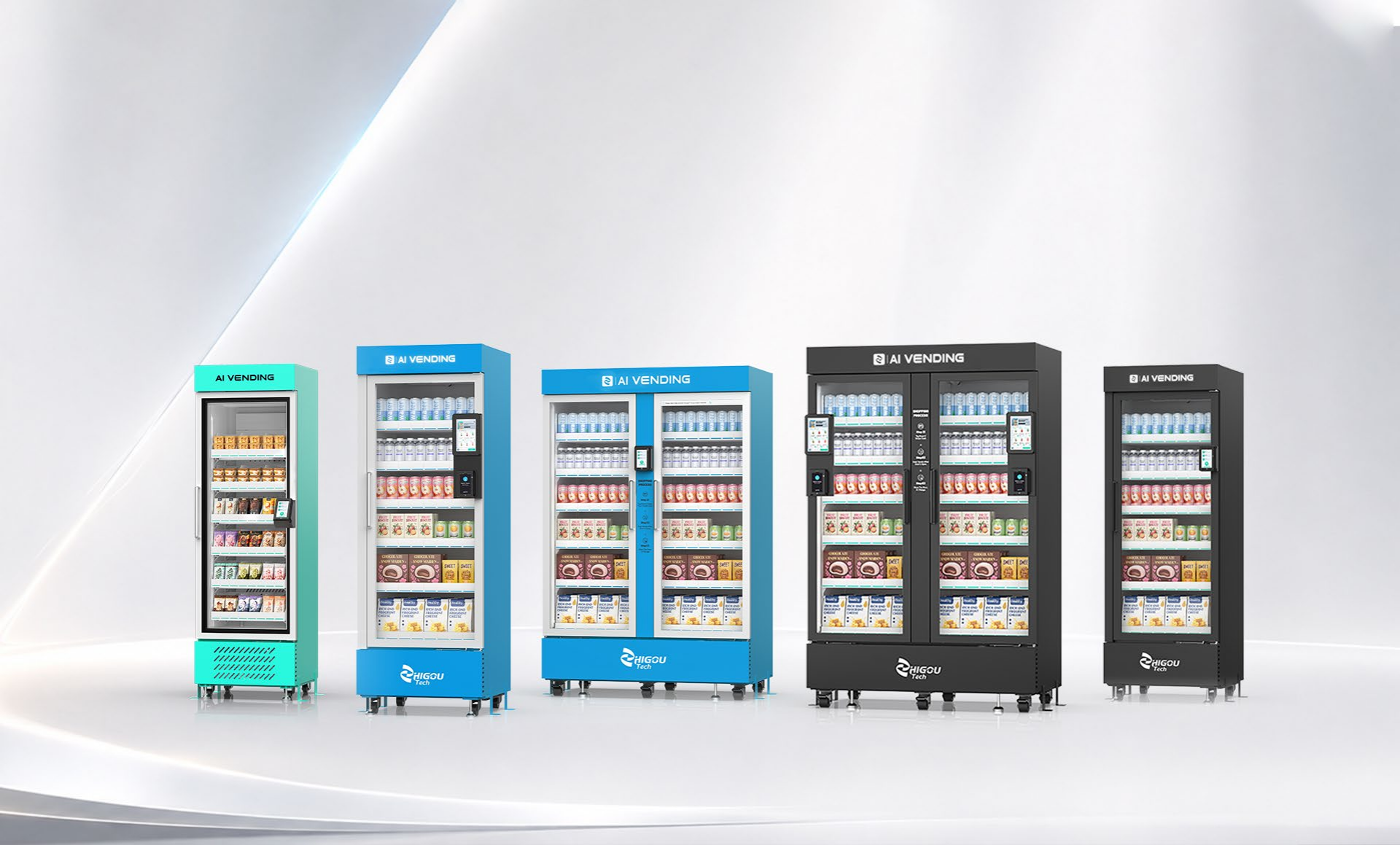
The AI-powered vending machine is available in several capacity specifications: 320L, 520L, 1000L, 270L. Different specifications can hold different quantities of canned goods, and there are differences in the length, width, and height of the cabinet body. The production machinery error is controlled within 5 millimeters.
*320L: Can hold 6 depth * 6 width * 4 layers = approximately 144 bottles. According to the standard of 300ml cans, it can hold 324 cans. Net capacity: 220 L.
*520L: Can hold 8 depth * 8 width * 5 layers = approximately 320 bottles. According to the standard of 300ml cans, it can hold 640 cans. Net capacity: 385 L.
*1000L: Capacity of 2 sets of 520L.
External dimensions (mechanical error 5mm):
*320L: 600*610*1785 (width*height*depth)
*520L: 700*707*1975 (width*height*depth)
*1000L: 1400*724*2000 (width*height*depth) 270L: 600*613*1955 (width*height*depth)
4. What are the Advantages and Disadvantages of an AI-powered vending machine?
AI Vision Vending Machine allows consumers to view and take multiple products directly. It is suitable for high-traffic locations such as offices, hotels, gyms, and industrial parks.
It has considerable potential to increase the average transaction value. When consumers purchase beverages, they are likely to also purchase snacks, bread, etc. It is suitable for venues with a wide variety of products and where impulse buying is likely to occur.
The AI-powered vending machine range is wide, and there is no need to rely on spring conveyor belts for automatic delivery. It can place various packaged goods with regular shapes and support AI recognition.
Operation risks and response methods
Product loss risk: Consumers can directly access the products in the cabinet. Abnormal purchasing behavior or recognition errors can lead to loss. By using built-in monitoring, background abnormal order alerts, payment pre-freezing, and standardized product display control for loss prevention;
The recognition cannot be 100% accurate: Environmental reflection, disorderly placement of products, light changes, and sensor interference can all affect the AI Vision Vending Machine effect. During the initial communication, it is necessary to inform the customers of the technical boundaries and not promise an absolute recognition accuracy rate;
The product placement threshold is high - AI recognition relies on real-shot product materials, unified packaging, and regular placement. During the intelligent vending machine’s operation, strictly follow the placement pictures and display specifications to place the goods.
5. How to Properly Place Products on AI-powered Vending Machine?
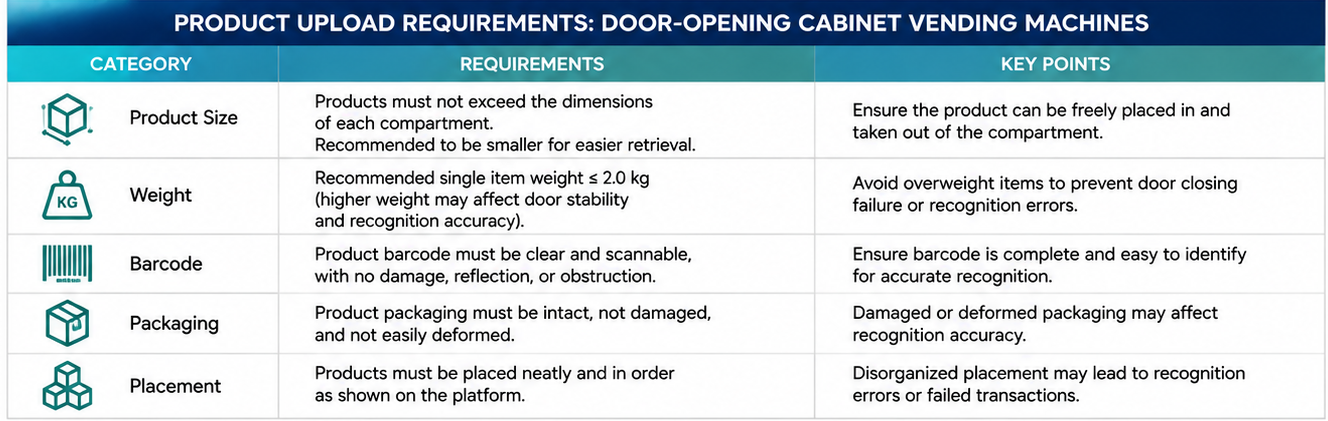
To ensure the stability of AI Vision Vending Machine and reduce abnormal orders, the products to be placed on the shelves must fully comply with the entire set of shelf placement regulations: the sum of the length, width and height of each item should reach the specified threshold; the thickness standard should follow the latest version of product specifications; the weight of each item should be greater than 100g; items with too light weight are prone to unstable recognition; the similarity of appearance of AI-powered vending machine in the same cabinet should not exceed 60%; colors should be similar and items of the same series should be recommended to be placed separately or sold in different cabinets; self-produced goods, unqualified products, transparent packaging, and goods with messy appearance packaging are not suitable for placement; AI Vision Vending Machine heavily relies on fixed and stable outer packaging; before placing on the shelves, 1-1 product real-shot images without reflective shadows and on a white background from multiple angles need to be prepared as training materials for the algorithm; all intelligent vending machines must be pre-entered on the equipment software background for shelf placement; products that have not been entered for shelf placement are prohibited from being sold; the equipment wear and tear caused by this should be borne by the operation department itself.
Conclusion
Overall, AI-powered vending machines have several advantages such as open shopping, increased average transaction value, and strong compatibility of goods. As long as the standards for product placement are strictly followed and daily display management is well done, the operational losses can be controlled within a reasonable range. When promoting and implementing in overseas markets, it is necessary to clarify the technical boundaries of the equipment, payment permission differences, and various operational risks. Objectively introduce the AI Vision Vending Machine and can fully leverage the commercial value of this equipment in office, hotel, and park scenarios.