You've undoubtedly heard about the possibilities these have to offer, whether you're a business owner looking to increase revenue by installing self-service vending machines in space that is currently being wasted, or you want to establish your own standard vending machine as a side gig for passive income.
The idea of vending machine investment, setting them up, and periodically replenishing them seems fantastic. The money comes in automatically. But are vending machines still profitable in 2026? Just how profitable are vending machines?
The short answer is yes, they certainly can be. Just how profitable they are, though, is another story. It depends heavily on location, product selection, pricing, operating costs, and machine utilization.
This guide explains what costs operators should consider, how to calculate potential profit, and which factors have the greatest impact on vending machine profitability.
What Are the Costs of Running a Vending Machine?
Understanding Startup Costs
Is a standard vending machine profitable after expenses? Profitability is not just about sales; it requires careful expense management. Let’s start by adding up some of the costs associated with running an automatic vending machine before getting into the revenue and profits you could earn.
Part of what may have drawn you to the idea of starting a vending machine business is how low the barrier to entry is. A basic spiral vending machine or AI vending machine is just a few hundred dollars. Even the more sophisticated types of vending machines cost under $10,000.
The specific price you pay for your self-service vending machines depends on the type, the brand, and the technology. There are classic change-based vending machines and more advanced cashless payment systems.
Aside from the vending machine business for sale, your only other startup cost will be the initial inventory for stocking the automatic vending machine. This could be snacks, candy, drinks, toy capsules, or other products. Budget somewhere between $200 and $1,000 per machine upfront.
You might have to pay rent depending on where you install your vending machine business for sale, too. However, many businesses are willing to let you place the automatic vending machine for free as a convenience to their customers.
If you do have to pay for the privilege to install your standard vending machine on a premise, though, it’ll likely come in the form of sales commissions rather than a monthly rental fee. This can be somewhere between 10% and 20%.
Continuous operating costs
Once your vending machine investment starts operating, continuous operating costs will arise, mainly in the areas of inventory replenishment and machine management.
Since inventory is your highest cost, purchasing in bulk helps maintain vending machine profit.
You also need to hire people to handle the replenishment and cleaning of the self-service vending machines you operate, but you can handle it yourself initially to further reduce costs. Professional maintenance may be required occasionally, especially for equipment that requires electricity and/or refrigeration.
How to Calculate Your Potential Vending Machine ROI?
Determining your return on investment (ROI) turns the idea of a vending machine business for sale into a solid plan. It measures how effectively your investment performs. According to financial analyses from Entrepreneur Magazine, each vending setup has a mix of fixed and variable costs that must be factored into ROI calculations.
The ROI formula is simple: divide net profit (total sales minus all costs) by total initial investment, then multiply by 100 for a percentage.
(Net Profit / Total Investment Cost) x 100 = ROI %
For instance, if you clear $1,500 in profit after investing $4,000, your ROI is 37.5%. This strong return outperforms many traditional investments and helps determine your payback period—the time needed to earn back your initial vending machine investment.
These principles apply across various investments, and similar strategies can be found in other asset classes, such as strategies to maximize investment returns for property owners.
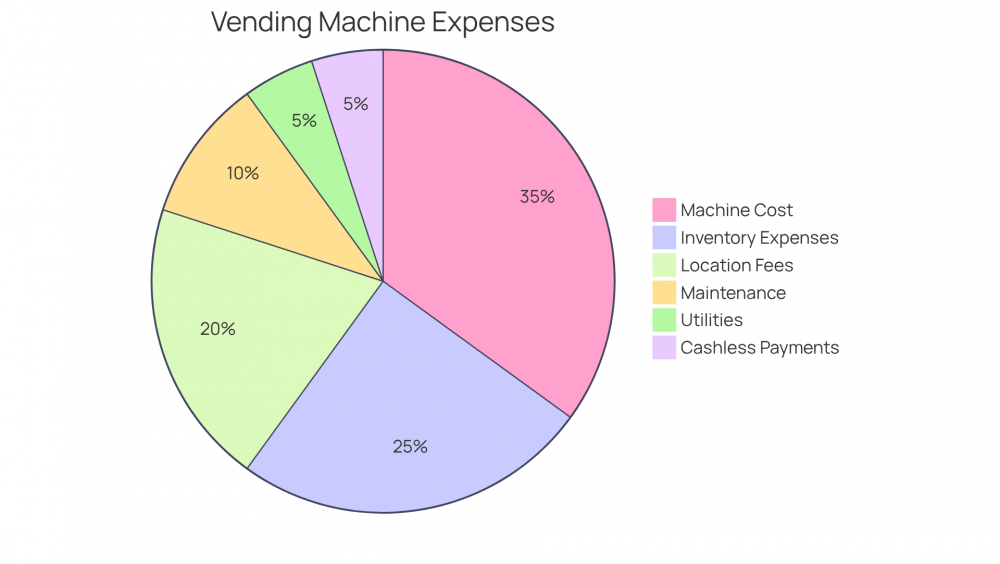
A chart can illustrate where your money goes initially, providing all necessary numbers for your ROI calculation.
Standard vending machine purchase is often the largest single expense, but don't overlook ongoing inventory and location fees—they significantly shape your monthly net profit.
Applying the Formula with Real Scenarios
Let's examine real-world examples. Understanding the formula is one thing; seeing how location and product choices affect financial outcomes is another.
The U.S. vending industry was valued at over $18.2 billion by 2023, with the average standard vending machine generating around $525 monthly. However, this average hides a broad range. Performance depends on placement and product offerings.
Scenario 1: High-Traffic Manufacturing Plant
Initial Investment: $5,000 (for a durable combo machine)
Monthly Gross Revenue: $900 (workers need energy drinks and substantial snacks)
Monthly Costs: $450 (products) + $90 (10% commission) + $50 (fees/maintenance) = $590
Monthly Net Profit: $900 - $590 = $310
Annual Net Profit: $3,720
Annual ROI: ($3,720 / $5,000) x 100 = 74.4%
Scenario 2: Mid-Sized Corporate Office
Initial Investment: $3,500 (for a sleek, modern snack machine)
Monthly Gross Revenue: $450 (steady afternoon snack traffic)
Monthly Costs: $225 (products) + $67.50 (15% commission) + $40 (fees/maintenance) = $332.50
Monthly Net Profit: $450 - $332.50 = $117.50
Annual Net Profit: $1,410
Annual ROI: ($1,410 / $3,500) x 100 = 40.3%
These examples highlight how profitability results from smart decisions. Keeping your automatic vending machine stocked and running smoothly while optimizing pricing is key to driving ROI higher.
Take the next step by exploring our vending machine business for sale at Zhigou. We carry the top brands and offer a price-matching guarantee to help maximize your ROI!
Key Factors That Determine Vending Machine Profitability
1. Location, Location, Location
Without question, location is the most critical factor in vending success. A good vending machine location with high foot traffic can generate 5-10 times more revenue than an average location. The best locations typically have:
· High foot traffic (1,000+ people daily)
· Captive audiences with limited alternatives
· Appropriate demographic for your products
· Long operating hours or 24/7 access
2. Product Selection and Pricing Strategy
Your product mix directly impacts both your revenue and profit margins. While traditional snacks and drinks remain popular, specialized vending machines offering unique products often command higher prices and generate greater excitement.
3. Machine Type and Technology
Automatic vending machines with advanced features significantly impact profitability. Newer machines offer:
· Multiple payment options (cash, credit, mobile pay)
· Remote monitoring capabilities
· Energy-efficient operation
· Better product preservation
· Enhanced security features
Here are the main drivers of vending profitability:
Factor | Impact |
High-traffic areas (offices, schools, transit hubs) = higher sales. | |
Product Mix & Pricing | The right pricing strategy improves both sales volume and margin. |
Inventory Control | Overloading machines wastes money; understocking loses sales. |
Servicing Efficiency | Time, fuel, and labor all cut into margins—optimize routes. |
Cash Reconciliation | Missing or miscounted cash = lost profit. Tracking is key. |
Conclusion: Are Vending Machines Profitable?
Yes, self-service vending machines can generate profits, but there is no guaranteed fixed sales volume or profit level.
The profitability of a vending machine business for sale depends on multiple interrelated factors, including location, product selection, pricing, equipment type, consumer demand, operating costs, and continuous management. For new operators, starting with a small number of machines, testing different locations, analyzing sales data, and continuously optimizing the product mix is a practical way to reduce investment risks and identify high-profit locations. We must understand that what really matters is not simply "placing more vending machines", but establishing a well-managed, data-driven, and scalable unmanned retail business system.
Reference
1. Blumer, K. (2025, November 24). Are vending machines a good investment for your business? VendMoore.
2. Gumball.com. (2025, March 17). Are vending machines profitable?
3. VendSoft. (2026, June 18). Vending machine profit: Real numbers for 2026.
4. [Author unknown]. (2025, September 22). Are vending machines profitable? The ultimate 2025 business guide.